Water Resource Management
Hydrogeology and catchment mapping, recharge structures, drinking water systems and water quality testing, sized to what the village baseline actually shows.
CSR · Rural Development
For CSR teams who want rural investment to add up to more than a scattered set of projects, CYARI plans, designs, implements and monitors comprehensive, village-level development programmes across water, livelihoods, climate and community infrastructure — end to end, in one accountable engagement.
Partners & collaborators
Village development plans draw on the same network of corporates, research institutions and grassroots organisations we work with everywhere else — not a separate roster assembled for CSR pitches.
 JK Lakshmi Cement Ltd.Corporate · Durg, Chhattisgarh
 Huber Engineered MaterialsCorporate · Germany
 Parmarth Samaj Sevi SansthanSocial Organization
 Society for Development AlternativesSocial Organization
 Adarsh Sewa SamitiSocial Organization
 Malaviya National Institute of Technology JaipurResearch InstituteJK Lakshmi Cement Ltd.Corporate · Durg, ChhattisgarhHuber Engineered MaterialsCorporate · GermanyParmarth Samaj Sevi SansthanSocial OrganizationSociety for Development AlternativesSocial OrganizationAdarsh Sewa SamitiSocial OrganizationMalaviya National Institute of Technology JaipurResearch Institute
Why a plan, not a project
Most village-level CSR work happens one intervention at a time. A Village Development Plan sequences the same budget against an actual baseline, so each intervention builds on the last.
Our methodology
The same sequence we use for every water and environment project, applied at village scale — from first survey to verified impact.
Household mapping, baseline surveys and resource assessment across water, land and livelihoods, done with the Gram Panchayat and community — and mapped against the Gram Panchayat Development Plan and other government schemes already active, so CSR spend complements rather than duplicates them.
Not sure a site is viable yet? Start with a feasibility studyTechnical designs and detailed project reports for each intervention, prioritised against the baseline and available budget.
On-ground construction and delivery, coordinated with local contractors, community labour and government schemes where relevant.
Handover with an operating and maintenance model, and capacity building of local committees — water user groups, SHGs — for real local ownership.
A monitoring and evaluation framework tracked against the original baseline, with CSR-ready impact reporting.
The outcome
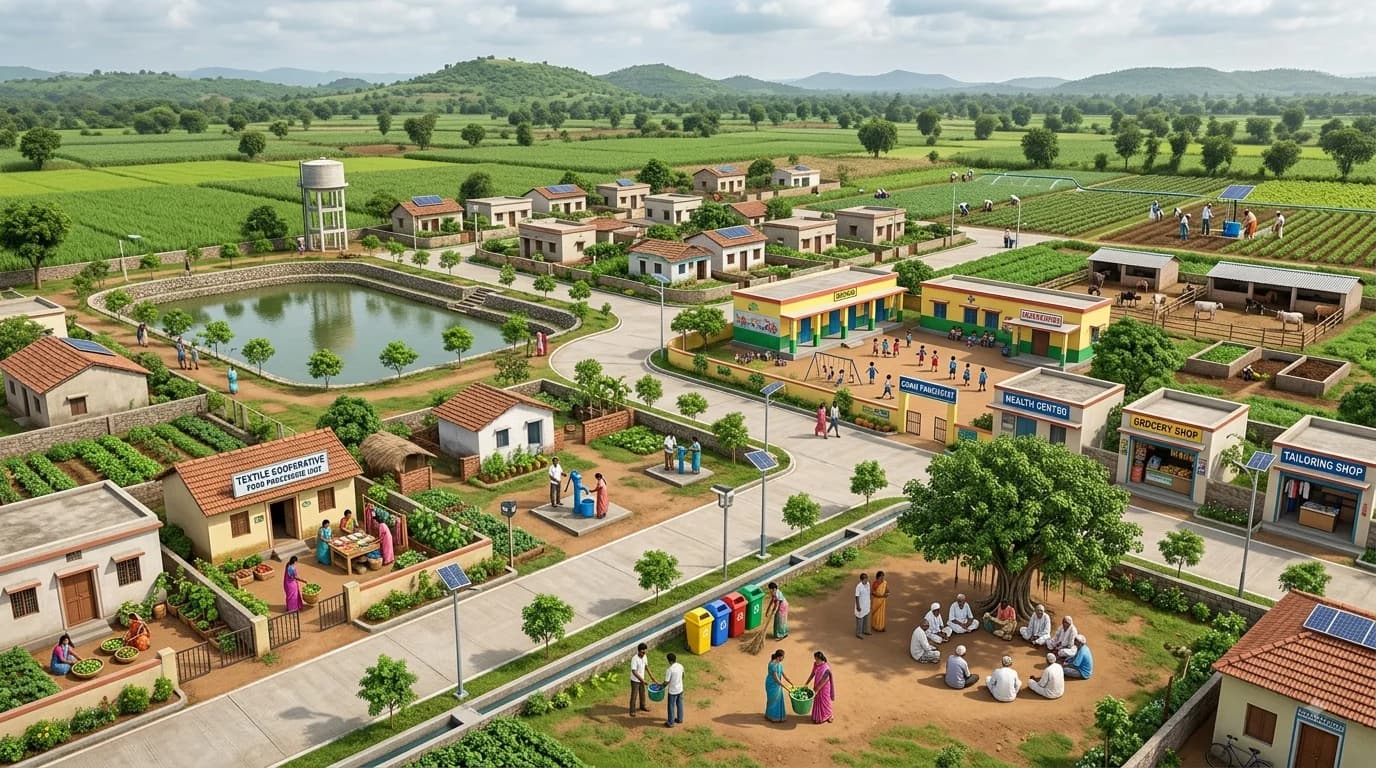
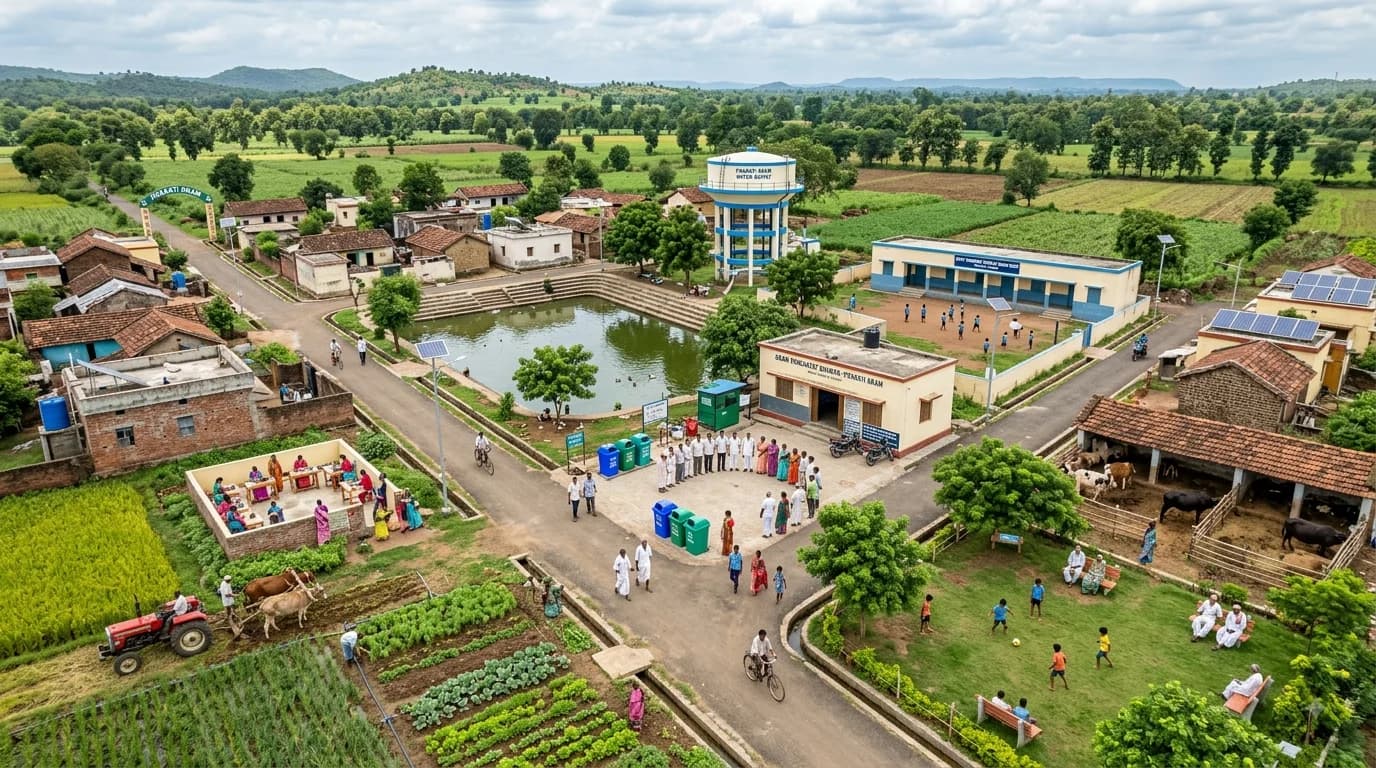
Water security, working livelihoods, a functioning school and health centre, waste segregation, solar power on rooftops — not isolated wins funded one at a time, but one system that keeps working together.
Scope of intervention
A village rarely has just one problem. The plan draws on whichever of these are relevant on the ground — sequenced together rather than run as separate projects.
Hydrogeology and catchment mapping, recharge structures, drinking water systems and water quality testing, sized to what the village baseline actually shows.
Natural farming, livestock and green-energy-based livelihoods designed to keep working after the CSR budget cycle ends, not just for the duration of the grant.
Land restoration, afforestation and nature-based solutions fitted to the village's own terrain and land-use pattern, not a generic planting target.
Local committees trained to run and maintain what gets built, plus the reporting CSR teams need to show a board what changed.
For plans already in motion
Not every engagement starts from zero. If a plan is already underway — built in-house, by another agency, or inherited from a previous CSR cycle — our expert panel can independently assess, monitor and evaluate its impact.
Why CYARI
CYARI Sustainability Solution Pvt. Ltd. is a registered private limited company with its own CIN and GST registration — a single accountable entity for the full engagement.
Teams that have surveyed, designed and delivered projects in Chhattisgarh, Haryana, Uttar Pradesh and Madhya Pradesh — not a plan written from a head office.
Construction, waste and water engineering services alongside scientific and technical consulting — so design and delivery don't sit with two different vendors.
CESR planning, project proposals for fund raising, and impact communication and reporting are already part of how we run engagements — not an add-on.
Questions
A structured, multi-year plan for a specific village that sequences interventions — water, livelihoods, climate, capacity building — against an actual baseline survey, rather than funding disconnected projects one at a time.
A contractor builds what they're asked to build. A village development plan starts with a baseline survey to establish what's actually needed and in what order, includes a technical design and DPR stage, and builds in an operating and maintenance model plus local capacity building so the asset keeps working after handover.
Baseline survey and design typically take a few months. Full execution and community handover for a comprehensive plan usually runs 2–3 years, with monitoring continuing afterward. Timelines are scoped to the village and the budget.
No — we're not limited to the states we've already worked in. We have field teams and delivery experience in Chhattisgarh, Haryana, Uttar Pradesh and Madhya Pradesh, but we're open to working PAN India. Tell us where you're looking and we'll confirm feasibility.
Yes. Planning includes mapping what's already active through the Gram Panchayat Development Plan and relevant government schemes, so CSR spend complements rather than duplicates them.
Yes — it doesn't need to be a CYARI-built plan. Our expert panel offers independent assessment, ongoing monitoring and impact analysis, including SROI reporting, for existing plans. This is also relevant if your CSR outlay requires independent impact assessment under the CSR Rules.
Baseline data, indicator-based monitoring reports, and impact communication and reporting prepared specifically for CSR board reporting and BRSR disclosure — not just site-visit photographs.
There isn't a fixed minimum. Share your indicative budget range and timeline in the inquiry form and we'll scope what's realistic.
Start a conversation
Share as much or as little as you know right now — geography, budget range, timeline. We'll follow up with a scoping call.